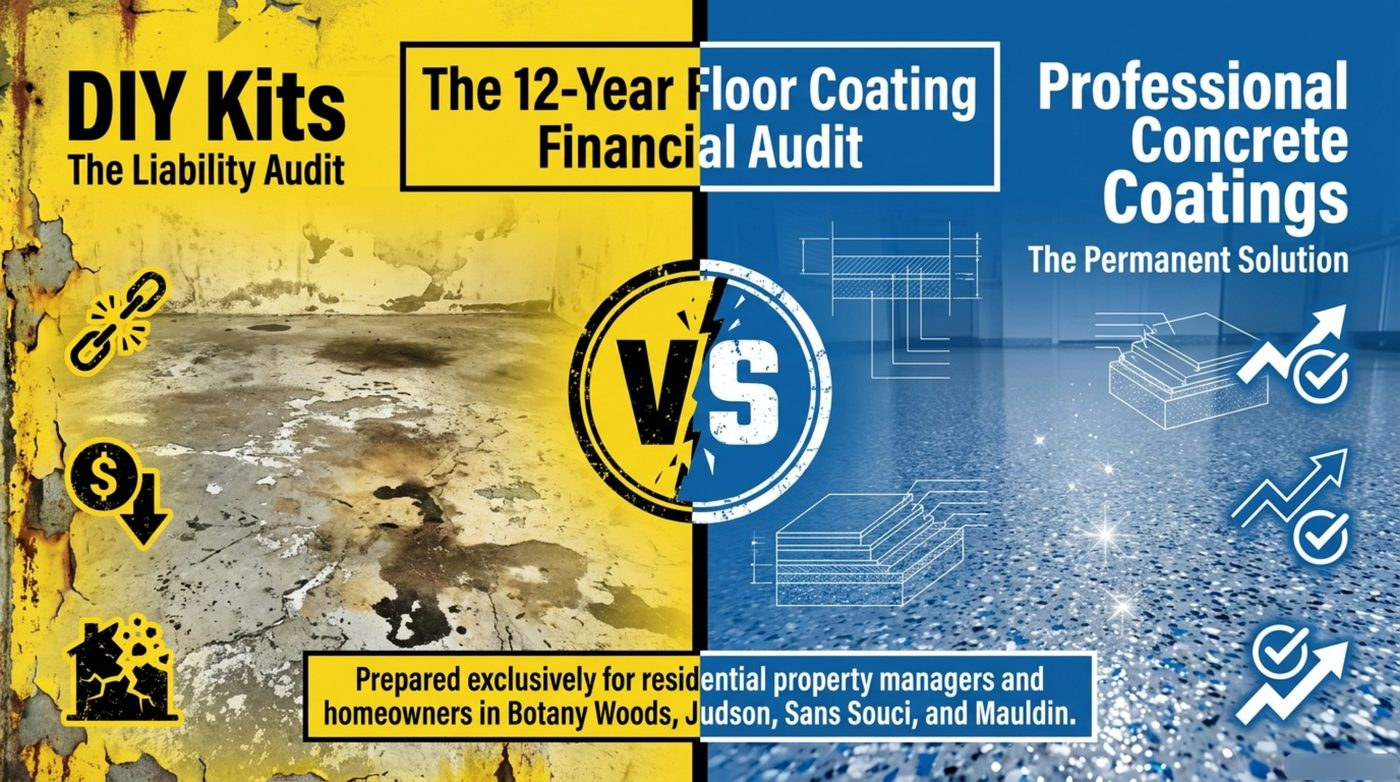
The 12-year floor coating audit: what actually happens to a DIY kit in North Texas
Most garage floor failures in Grand Prairie, Arlington, and Mansfield do not begin on installation day. They begin around month 18, when the first patch goes down over a blister, and they end whenever a homeowner finally adds up what the floor cost to own. That total is what a 12-year audit measures: not the price of a bucket of coating, but money, weekends, and labour tracked across a full ownership cycle. If you have been weighing up epoxy garage floor for a home around Grand Prairie, TX, this guide covers how it actually works, what it tends to cost, and where the results usually fall short.
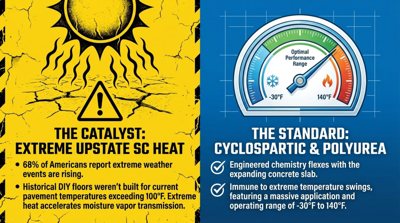
A do-it-yourself kit is priced to look inexpensive on a Saturday morning at the home centre. It is not priced to survive a North Texas summer of 140°F pavement, with ice-storm brine tracked in off I-20, expansive clay shifting under a DeSoto driveway, and tires left hot on the slab in August.
The short version
- The audit runs a fixed 144-month clock with checkpoints at 0, 18, 36, 54, 72, 90, 108, 126, and 144 months, long enough for every hidden cost in a thin coating to surface more than once.
- Initial outlay on the DIY path averages $5.00 to $15.00 per square foot including coating, etcher, roller covers, and the extra bucket, and the 12-year total reaches $720 to $1,920 plus 12 lost weekends.
- North Texas conditions shorten a thin floor's life: 140-degree pavement in summer, ice-storm brine tracked off I-20, expansive clay movement under a DeSoto driveway, and humid summers pushing moisture vapor up through the slab.
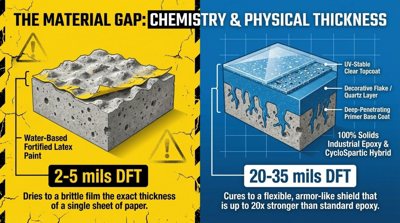
- Dry film thickness decides survival, since DIY latex and water-based systems dry at 2 to 5 mils while a 100 percent solids hybrid cures at 20 to 35 mils and is up to 20 times stronger.
- Surface preparation is the second decisive figure, because an acid wash only scratches the surface while diamond grinding and shot blasting reach an ICRI Concrete Surface Profile of CSP 3 to 4.
- A professional system takes full vehicle traffic in 24 hours against the DIY path's 30-day curing trap, and a quote should answer five questions: thickness, chemistry, preparation, return-to-service time, and warranty.
What follows is the audit itself — where the money goes, which numbers decide whether a floor holds up, and how to read an estimate so that you are comparing systems instead of prices.
Where the money actually goes across 12 years
The audit runs on a fixed clock: 0 months at install, then checkpoints at 18, 36, 54, 72, 90, 108, 126, and 144 months. That is twelve years of ownership, long enough for every hidden cost inside a thin coating to surface more than once.
Initial capital outlay on the DIY path averages $5.00 to $15.00 per square foot — and that already includes the coating, the etcher, the roller covers, and the extra bucket you buy when the first one runs short on a two-car slab in Cedar Hill. By the end of the cycle the DIY path reaches a final total cost of ownership of $720 to $1,920, plus 12 lost weekends of stripping, patching, and re-application.
| 12-year audit line | DIY kit path | Professional system path |
|---|---|---|
| Initial capital outlay | Average $5.00–$15.00 per sq ft | One-time investment |
| Month 18 checkpoint | First patch and re-application cycle | No maintenance event |
| Months 18 to 144 | Continuous stripping, patching, re-application | Simple mopping |
| Personal labour | 12 lost weekends (about 3 months of work) | Zero weekend labour |
| Final 12-year total cost of ownership | $720–$1,920 plus 12 lost weekends | Zero financial upkeep over 15+ years |
| Return to service after install | 30-day curing traps | Full vehicle traffic in 24 hours |
Read the shape of the two columns rather than the totals. The professional path is a flat line: one investment, then nothing but simple mopping for 15+ years. The DIY path is a staircase of small payments and lost Saturdays that keeps climbing until the slab is stripped back and started over.
Twelve lost weekends is roughly three months of personal labour, and it arrives in the worst possible pattern — a Saturday here in April, another in October, never a block of time you can plan around. That is the line most homeowners undercount when they compare a kit on the shelf with a professional quote.
Why a North Texas garage shortens a DIY floor's life
Grand Prairie, Arlington, and Cedar Hill slabs live through ice-storm brine, expansive clay movement, and humid North Texas summers. Water finds hairline cracks, freezes, expands, and lifts whatever is glued over the top of it. A film measured in single-digit mils has nothing to fight that with, so the edges curl first and the traffic lanes go next.
Then the season flips. Pavement temperatures in Midlothian and Mansfield push past 100°F, and extreme heat accelerates moisture vapour coming up through the slab. Vapour pressure does not care that the coating looked perfect in October. It pushes upward until something gives, and the thinnest layer in the system gives first.
The curing schedule compounds it. A DIY path leaves you managing a 30-day curing trap before the floor is truly ready for daily traffic, while a professional system is built to take full vehicle traffic in 24 hours. In a two-car household, that difference is not a technical footnote — it is three or more weeks of cars parked in the driveway.
The numbers that decide the outcome
Two figures separate a floor that survives the audit from one that fails it. The first is dry film thickness: DIY latex and water-based systems dry at 2–5 mils, the exact thickness of a single sheet of paper, while a 100% solids hybrid cures at 20–35 mils into a flexible, armour-like shield that is up to 20x stronger than standard epoxy. A film that thin dries brittle, and a brittle film has no way to absorb slab movement.
The second figure is the surface profile. An acid wash merely scratches the surface and leaves existing sealers, old paint, and deep motor oil in place; diamond grinding and shot blasting achieve an ICRI Concrete Surface Profile of CSP 3–4, opening the pores so the coating becomes part of the floor. On a properly profiled slab, the concrete will break before the chemical bond fails.
Those two numbers also explain the maintenance column of the audit. Thin film plus weak bond equals a relentless patching cycle, while a full-thickness system on a profiled slab needs nothing more than a mop.
How to audit an estimate in ten minutes
You do not need a laboratory to review a quote. You need the quote to answer five questions in writing, because the answers are what the 12-year numbers depend on.
What dry film thickness is specified for the finished system, and how many coats get you there?
Is the coating a 100% solids hybrid, or a water-based product that dries thin?
What surface preparation method is included — acid wash, or diamond grinding and shot blasting to a stated CSP profile?
How soon after installation can vehicles park on the floor?
What does the warranty cover, and who performs the work?
A quote that answers those five questions is auditable. A quote that only lists a total price is a guess, and the person carrying the risk of that guess is the homeowner in Mansfield or Grand Prairie paying the invoice.
Frequently asked questions about the 12-year floor coating audit
Is a DIY epoxy kit actually cheaper over 12 years?
On day one, yes — the outlay averages $5.00 to $15.00 per square foot. Across the full 12-year window, the DIY path ends at $720 to $1,920 in direct cost plus 12 lost weekends of stripping and patching. The professional path is a single investment with zero financial upkeep over 15+ years, so the comparison depends on whether you count your weekends as free.
How often does a thin DIY floor need attention in North Texas?
The audit's first checkpoint is month 18, and from there the cycle repeats: patch, strip, re-apply. Because a 2–5 mil film has no thickness to sacrifice, every blister or lifted edge becomes a repair rather than a scuff.
What should be written into a professional quote before I sign?
Thickness, chemistry, preparation method, return-to-service time, and warranty terms. Ask for the dry film thickness in mils and the surface profile in CSP terms, and confirm the floor takes vehicle traffic in 24 hours rather than 30 days.
If your current floor is already at the patching stage, it is worth pricing the replacement before the next winter: call (972) 850-7986 for a free assessment across Grand Prairie, Arlington, Irving, Mansfield, Duncanville, DeSoto, Cedar Hill, and Midlothian. You can also work through our free calculators to size your slab and budget, or read the DIY versus professional breakdown before you commit to either path.