Anchor or blanket? How coating adhesion actually works
Every floor coating failure in a North Texas garage traces back to one question: did the material anchor into the concrete, or did it just lay on top like a blanket? A retail kit and a professional system use different chemistry to answer that question, and the difference shows up the first time water finds a way under the film. This is written for homeowners around Grand Prairie, TX who are looking into epoxy floor contractor and want the honest version rather than a sales page.
A water-based, amber-tinted liquid is what most homeowners picture when they think of epoxy paint. It spreads easily, dries to the touch in hours, and covers a slab in a single weekend. A professional system uses a solvent-free resin that soaks into the concrete and cross-links inside the pore structure, so the bond is chemical rather than mechanical-on-the-surface.
The short version
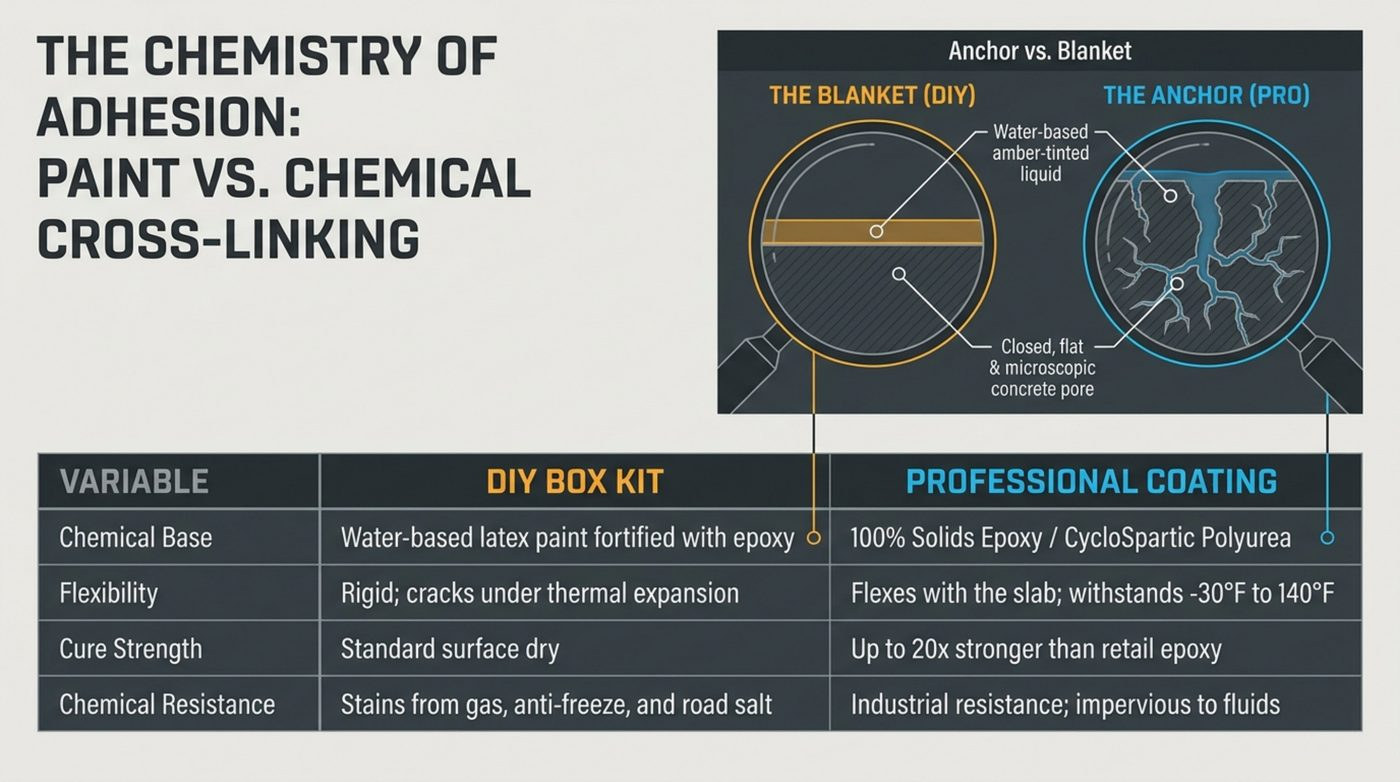
- A retail box kit is water-based latex paint fortified with epoxy, while a professional coating is 100% solids epoxy or cycloaliphatic polyurea applied over a slab that has been opened mechanically.
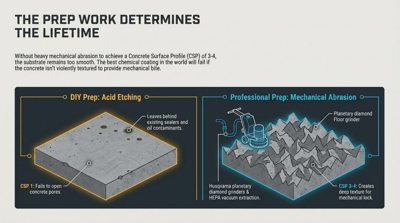
- Opening the pore structure gives the same coating hundreds of tiny mechanical locks per square foot, which is why an installer spends more time preparing a floor than coating it.
- A professional system is formulated to move with the slab across -30°F to 140°F, while a rigid water-based film has no such range and cracks along the joints and control cuts.
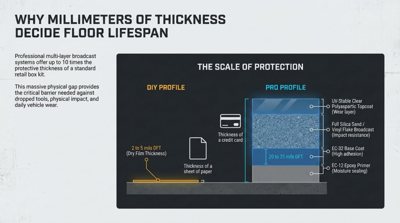
- A professional coating cures up to 20x stronger than retail epoxy, which is the difference between a floor that can take a dropped jack stand and one that cannot.
- Debonding almost never starts in the middle of a floor but at the edge, where water, salt and air reach the bond line first and travel further than is visible by the time a lifting corner is noticed.
The word "adhesion" hides all of this. There are two kinds of adhesion in flooring, and only one of them survives a decade of salted tires and freeze-thaw cycling in Grand Prairie, Arlington, Irving, Mansfield, Duncanville, DeSoto, Cedar Hill, and Midlothian.
The blanket: how a retail kit bonds
A retail box kit is water-based latex paint fortified with epoxy. That formula is designed for a homeowner with a roller and a free Saturday, which means it is thin, slow to build, and dependent on whatever grip the existing slab surface happens to offer.
Lay it over a closed, flat, microscopic concrete pore and you get a film sitting on a nearly smooth surface. It looks bonded because it is stuck at the edges. In practice the bond is variable, and variability is the problem: the same application method can hold for years in one part of a garage and lift in another.
The failure pattern follows the weaknesses. Water gets under a rolled edge, a tire footprint, or a hairline crack, and the blanket starts to detach. Once the film is no longer continuous, the concrete underneath begins to take on moisture and stain.
The anchor: how a professional system bonds
A professional coating is 100% solids epoxy or a cycloaliphatic polyurea, applied over a slab that has been opened up mechanically. With no water carrier to evaporate, the film builds real thickness in place and cures into a hard, integrated layer.
Because the pore structure is open, the resin penetrates before it sets. That is the anchor. The coating is not relying on surface grip alone, it is locked into the concrete itself and cross-linked through its own chemistry.
| Property | DIY box kit | Professional coating |
|---|---|---|
| Chemical base | Water-based latex paint fortified with epoxy | 100% solids epoxy / cycloaliphatic polyurea |
| Flexibility | Rigid, cracks under thermal expansion | Flexes with the slab, withstands -30°F to 140°F |
| Cure strength | Standard surface dry | Up to 20x stronger than retail epoxy |
| Chemical resistance | Stains from gas, anti-freeze, and road salt | Industrial resistance, impervious to fluids |
Why the pore structure decides everything
A concrete pore that is closed and flat offers almost no surface area for a coating to hold onto. Multiply that by a whole garage slab and the film is essentially resting on the surface, held by a shallow grip that degrades with every temperature swing.
Open the pores and the same coating has hundreds of tiny mechanical locks per square foot. This is why an installer will spend more time preparing a floor than coating it. Chemistry cannot compensate for a slab that was never given anything to bond to.
Temperature: the -30°F to 140°F test
A rigid film cracks when the slab beneath it expands and contracts. North Texas slabs do exactly that, from below-freezing nights in January to pavement surfaces that hold serious heat in July.
A professional system is formulated to move with the slab across a -30°F to 140°F range, staying intact at both ends. A rigid water-based film has no such range, which is why hairline cracks in a DIY floor tend to appear along the same lines as the joints and control cuts in the concrete.
Strength and stain resistance follow the chemistry
Cure strength is where the numbers get stark. A professional coating cures up to 20x stronger than retail epoxy, which is the difference between a floor that can take a dropped jack stand and one that cannot.
Chemical resistance follows the same line. Gas drips, anti-freeze, and road salt leave permanent marks in a thin water-based film. An industrial-grade system is impervious to those fluids, which matters in a garage that sees a lawn mower, a snow blower, and two daily drivers parked over the same square metres.
Where debonding starts in a North Texas garage
Failure almost never begins in the middle of an open floor. It begins at the edge, because an edge is where water, salt, and air reach the bond line first. A garage in Grand Prairie that sees ice-storm melt off two cars gives that edge a fresh supply of brine for months.
From the edge it travels. Summer heat and clay movement open the gap a little further each season, and by the time a homeowner in Duncanville or DeSoto notices a lifting corner, the bond has usually failed along a longer run of the perimeter than is visible.
An anchored coating has no such opening. Because the resin is cross-linked inside the pore structure rather than riding on the surface, the perimeter behaves like the rest of the floor, and there is no leading edge for water to work at.
Frequently asked questions about coating adhesion
What does "anchor" mean in floor coating terms?
It means the resin penetrated the open pores of the concrete and cured there, creating a chemical and mechanical lock instead of a surface bond. An anchored coating is integrated with the slab, so it does not peel away in sheets.
Can I improve adhesion on a DIY kit by cleaning the floor first?
Cleaning removes dirt and surface oil, but it does not open the pore structure. Without mechanical abrasion the slab stays too smooth for any coating to anchor, which is why retail kits are described as surface-level adhesion only.
Does a professional coating really withstand temperature swings?
Yes. A professional system withstands -30°F to 140°F and flexes with the slab rather than cracking against it, which is the property a rigid water-based film does not have.
Adhesion is the whole argument for a professionally installed floor, and our guide to common epoxy flooring problems shows what surface-level bonding looks like once it starts to fail. Call Grand Prairie Epoxy Floors at (972) 850-7986 to compare local providers serving Grand Prairie, Arlington, and the rest of North Texas.