What Destroys Epoxy - published guidance, explained without the sales pitch.
Chemical resistance profiling: how to read the ratings
Every resinous floor sold into North Texas arrives with a chemical resistance chart, and almost nobody reads the legend. That is the mistake. The letters and numbers on that chart are a commitment about how long a chemical can sit on the floor before it starts doing damage, and they are written in a shorthand that takes five minutes to decode. Most homeowners who read this are comparing epoxy floor contractor options around Grand Prairie, TX, so what follows sticks to the details that change in practice.
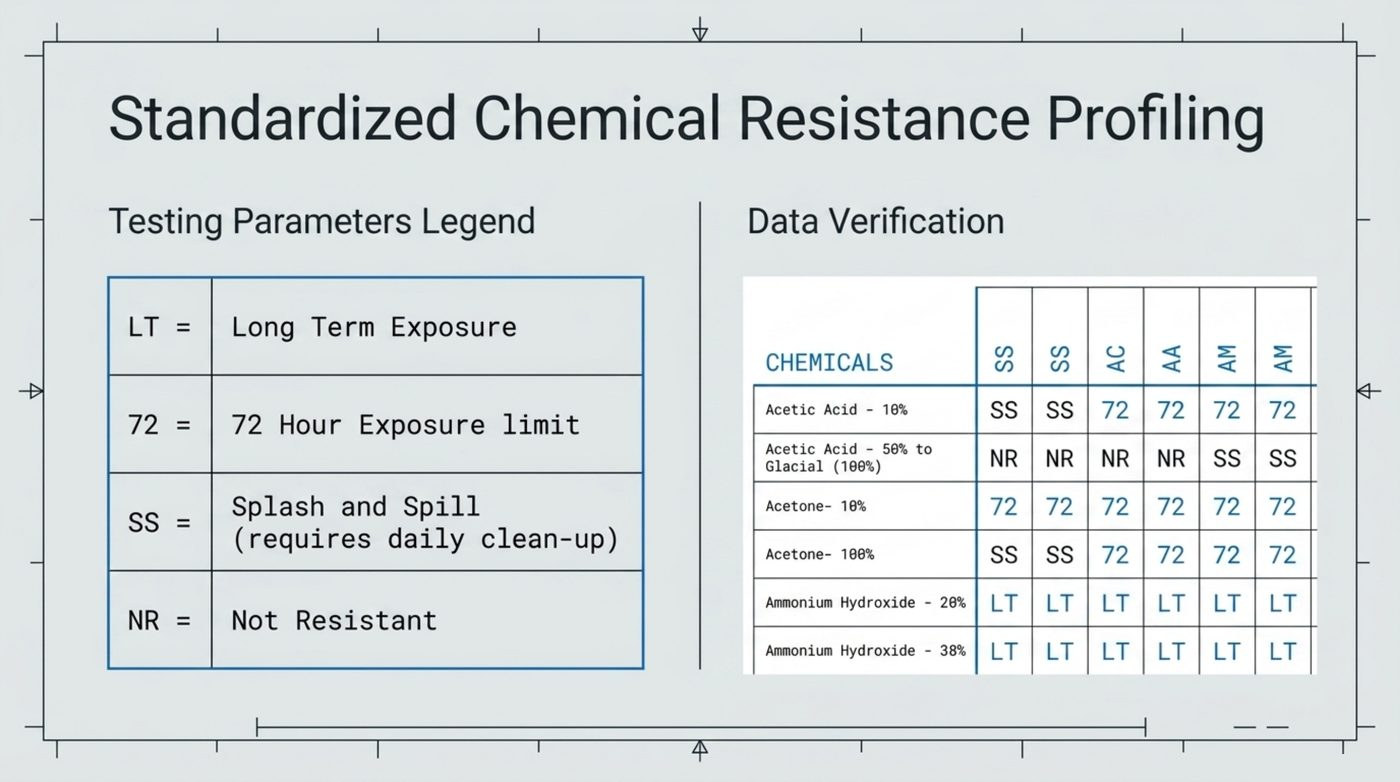
The shorthand is four entries. LT means long-term exposure — the chemical can stay in contact indefinitely without harming the film. A number means an exposure limit in hours: 72 means the spill must be cleaned within 72 hours. SS means splash and spill, which requires daily clean-up. NR means not resistant, and that chemical should not touch the floor at all.
The short version
- The chart legend has four entries: LT for long-term exposure, a number as an exposure limit in hours, SS for splash and spill requiring daily clean-up, and NR for not resistant.
- Acetic acid at 10% may carry an SS rating or a 72-hour limit depending on the system, but pushed to 50% and up to glacial 100% it drives four columns to NR and leaves only two at SS.
- Acetone runs the reverse pattern: at 10% the whole row reads 72, while at 100% two columns drop to SS and the remaining four stay at 72 hours.
- Ammonium hydroxide reads LT at both 20% and 38% concentration, which is the profile wanted on a floor under a pressure washer with a cleaner additive or in a laundry zone.
- Where a chemical lands in the NR column the fix is to change the storage rather than the floor, since a containment pan under a solvent shelf costs a fraction of a recoat.
Get those four straight and a chart that looked like alphabet soup becomes a maintenance schedule. For a garage in Mansfield or Irving where the floor sees ice-storm brine in February and brake fluid year round, the difference between an LT rating and a 72-hour rating is the difference between mopping when you get around to it and mopping the same day.
The four ratings, decoded
The legend the deck uses is deliberately blunt. LT is the only rating that describes a floor as safe under standing contact. The numbers describe a window, not a free pass — 72 means 72 hours, and after that the chemistry wins. SS is the weakest pass rating, because splash and spill exposure with daily clean-up is a schedule rather than a tolerance. NR is the floor telling you no.
| Rating | Meaning | What it demands of you |
|---|---|---|
| LT | Long-term exposure | No special urgency; standard cleaning routine is enough |
| 72 | 72-hour exposure limit | Spills must be cleaned within 72 hours and never left standing |
| SS | Splash and spill | Requires daily clean-up of any contact |
| NR | Not resistant | Avoid contact entirely; contain and remove at once |
Acids: the split between 10% and glacial
Acetic acid is the clearest example of concentration deciding the rating. At 10%, a system may carry an SS rating in some columns and a 72-hour limit in others — meaning a diluted spill is survivable if it is dealt with promptly and cleaned daily while it sits. Push the same acid to 50% and up to glacial (100%) and the chart turns hard: four columns read NR and only two hold at SS.
The lesson for a homeowner is that the label on the bottle is part of the data. Vinegar, pool acid, tile-cleaning acid and laboratory-grade glacial acetic acid are all "acid", and they occupy opposite ends of the same row. If a shelf in your Cedar Hill shop holds the concentrated version, that shelf belongs over a containment tray, not on an open floor.
Solvents: acetone at 10% and at 100%
Acetone is the reverse pattern. At 10%, the row reads 72 across the board — every system in the profile tolerates it for up to 72 hours. At 100%, two columns drop to SS and the remaining four stay at 72, which is a narrower but not catastrophic profile.
That gradient is why a bucket of wasted acetone should be sealed and removed rather than left open to evaporate. Evaporation happens overnight; the 72-hour window is generous on paper but you will not notice the difference between a slow attack and no attack until the sheen goes dull.
Ammonium hydroxide: the all-day rating
Ammonium hydroxide is the opposite case. At 20% concentration the entire row reads LT, and at 38% the columns continue to read LT. This is the chemical profile you want to see on a floor that will live under a pressure washer with a cleaner additive, or in a basement laundry and utility zone in Irving where alkaline cleaners get diluted and mopped routinely.
An LT rating is not a licence to ignore the floor, but it does remove the clock. No 72-hour countdown, no daily clean-up requirement — just the ordinary sweeping and mopping that any finished floor needs. That distinction is worth having when you compare systems: two floors can both look resistant on a chart while only one of them tolerates a spill left overnight.
Using the chart on a Grand Prairie floor
The practical move is to inventory what actually touches your floor and sort it by rating. Road brine and de-icing salt in February, motor oil and anti-freeze from a daily-driving vehicle, bleach at 5% in a laundry corner, brake fluid from a project car — each of those needs to land in the LT column or the maintenance routine changes for the rest of the floor's life.
Where a chemical lands in the NR column, change the storage, not the floor. A containment pan under a solvent shelf costs a fraction of a recoat and does the job the coating cannot. If the exposure list is long, the honest next step is to revisit the build itself — build thickness and broadcast media are discussed on the flake and chip systems page, and failure modes caused by chemical attack are collected under epoxy flooring problems.
Frequently asked questions about chemical resistance ratings
What does LT mean on a chemical resistance chart?
LT stands for long-term exposure and it is the strongest rating in the legend. It means the chemical can remain in contact with the floor without a deadline, unlike a 72-hour limit or an SS splash and spill rating that requires daily clean-up.
How long do I have to clean up a spill rated 72?
72 hours. The number is an exposure limit in hours, so a spill rated 72 must be cleaned up within three days. Anything rated SS should be cleaned the same day, and anything rated NR should be contained and removed immediately.
Does a higher concentration change the rating for the same chemical?
Yes, and dramatically. Acetic acid at 10% can rate SS or 72 depending on the system, while acetic acid at 50% up to glacial 100% drives four columns to NR. Always match the rating to the concentration you actually store.
Bring us the list of chemicals your Grand Prairie, Irving or Midlothian floor has to live with and we will tell you which ratings you need to insist on. Call Grand Prairie Epoxy Floors at (972) 850-7986, or review the epoxy flooring FAQ for the other questions that come up before a specification is written.