Five years of wear: what a working garage does to a coated floor
Grand Prairie garages work far harder than showroom photos suggest. A slab that spends five years under two daily drivers, a snowblower, a stack of jack stands, and a rotating collection of half-empty paint cans is a work surface, not a display surface. By the fifth summer, the gap between a system built for that abuse and a coating that was simply rolled on is no longer a matter of opinion — it is visible in the finish. If you have been weighing up epoxy garage floor for a home around Grand Prairie, TX, this guide covers how it actually works, what it tends to cost, and where the results usually fall short.
North Texas accelerates the test. Ice-storm brine tracked in from I-20, I-30, and TX-360 sits on the floor as a wet chemical film for months. Summer humidity pushes moisture through bare concrete. Expansive clay movement from one season to the next pries at every weak edge. Five years of that treatment, and a thin film starts telling the truth about what it is.
The short version
- Chemical staining is usually visible after the first full brine season and impact chipping typically begins within two years on a thin film, making the pattern unmistakable by year five.
- A thin decorative enamel absorbs gasoline, anti-freeze and road salt and holds them against the concrete, producing permanent dark blotches under the parking spots.
- Anti-slip texture comes from crushed quartz or decorative flake broadcast into the wet base coat, so the grit is part of the film rather than a mat laid on top of it.
- Texture is also the first thing cheap coatings lose, because five years of scrubbing and sun exposure burnishes a thin surface until slip resistance is gone entirely.
- A full build is designed for zero upkeep with mopping as the entire maintenance program, while a thin film demands a repeating cycle of patching, stripping and re-application.
- A single-car garage in Cedar Hill or Midlothian fails more slowly rather than differently, because brine, gasoline and anti-freeze still reach the slab.
What follows is a criterion-by-criterion look at what a working garage does to a coated floor across five years, and which build details decide whether the surface survives with its appearance intact.
Chemical resistance: gasoline, anti-freeze, and road salt
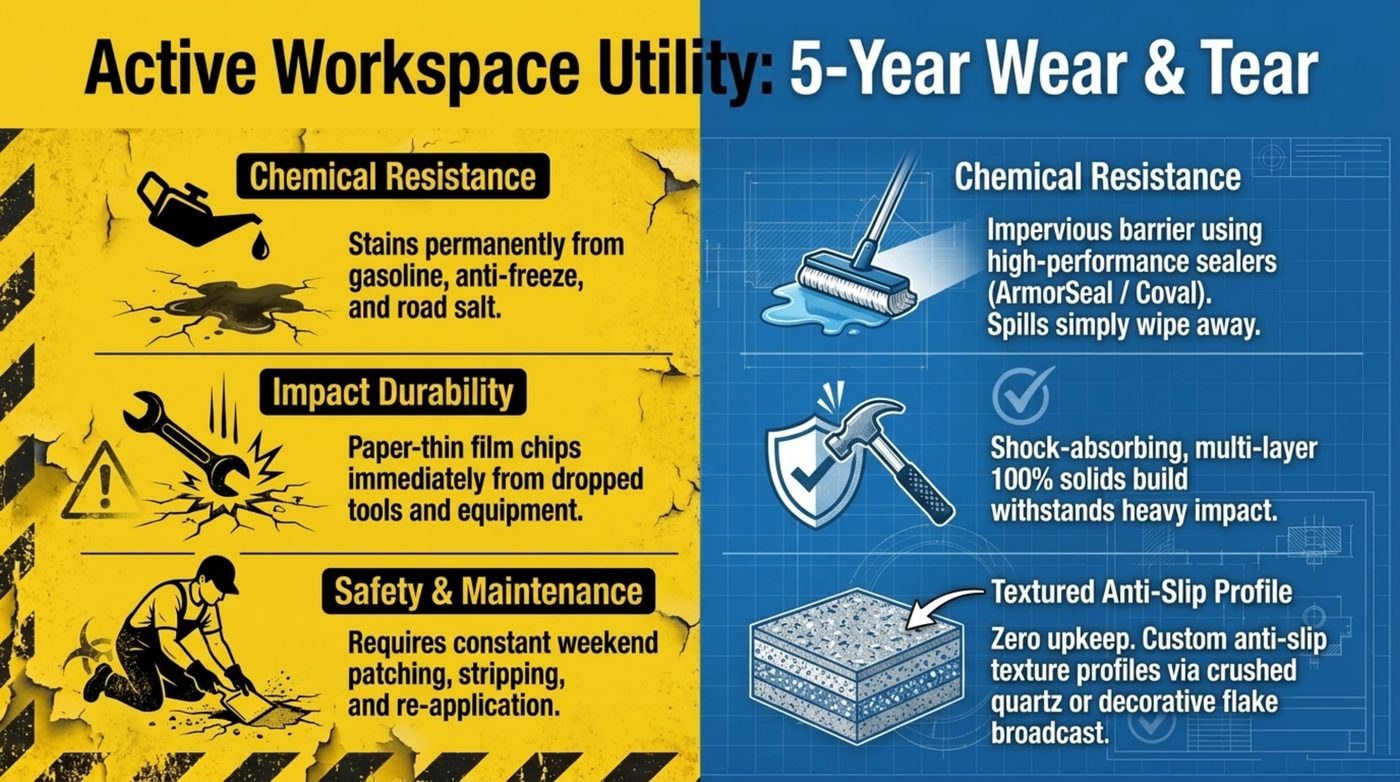
Gasoline drips at the filler neck, anti-freeze weeps from a radiator hose, and ice-storm brine arrives on tires through the winter. A thin decorative enamel absorbs those fluids and holds them against the concrete. The result is the familiar map of dark blotches under the parking spots — stains that set permanently from gasoline, anti-freeze, and road salt, no matter how quickly an owner wipes them up.
A high-performance sealing system works in the opposite direction. An impervious barrier keeps the chemistry on the surface instead of inside the slab, so spills simply wipe away. Owners in Mansfield and DeSoto who park year-round tend to notice the difference first on the tire footprint, the one zone that sees the heaviest brine exposure every winter.
Five years is ample time for a thin film to fail this test visibly. A properly sealed build at the same age typically still looks like it did in year one.
Impact durability: what a dropped tool does to a thin film
Ask a homeowner what actually damages a garage floor and the answer is rarely oil. It is a dropped breaker bar, a floor jack wheeled across a rough patch, a snowblower dragged side to side in February. A paper-thin film chips immediately under that kind of point load, and each chip widens as water and salt work into the exposed concrete.
A shock-absorbing, multi-layer 100% solids build spreads the same impact across the film thickness instead of concentrating it in one spot. Dropped tools and equipment that would crater a painted surface leave a mark that wipes off. That resilience is a function of what is in the bucket, not of how carefully the homeowner handles a wrench.
Anti-slip texture through five North Texas summers
Wet shoes, melted snow, and a car dripping onto a smooth finish add up to a slick slab by February. A properly built garage floor carries a textured anti-slip profile — a custom texture delivered through a crushed quartz or decorative flake broadcast into the wet base coat. The grit is part of the film, not a mat laid on top of it.
Texture is also the first thing cheap coatings lose. Five years of scrubbing and sun exposure burnishes a thin surface until the slip resistance is gone entirely. Builders in Arlington and Irving who specify a broadcast texture up front are still sending clients onto the same safe surface five summers later.
Maintenance: the weekend cycle that never ends
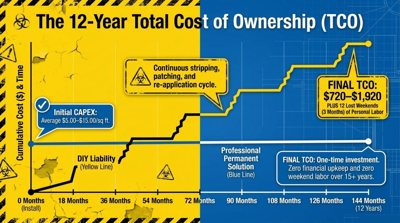
Here is where five years of ownership separates the two paths most clearly. A thin film on a working slab requires constant weekend maintenance: patching the chips, stripping the worn zones, and re-applying the coating, then waiting out the cure again. Those weekends are permanent, repeating work that never actually finishes.
A full build is designed for zero upkeep. Mopping is the entire maintenance program. When a Duncanville or Irving owner adds up what five years of patching, stripping, and re-application actually consumed, the labor almost always outweighs the gap in the original quote.
The five-year verdict
By year five, the two surfaces have stopped resembling each other. One is a worn, patched, re-coated film with chemical staining under the tires; the other is a thick build that still wipes clean and holds its texture. The comparison below is what a working garage measures over that span.
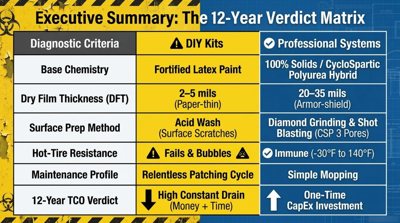
| Criterion at year 5 | Thin-film paint coating | 100% solids multi-layer build |
|---|---|---|
| Chemical resistance | Permanent stains from gasoline, anti-freeze, and road salt | Impervious barrier; spills wipe away |
| Impact durability | Paper-thin film chips immediately from dropped tools | Shock-absorbing build withstands heavy impact |
| Anti-slip profile | Texture burnished away by scrubbing | Custom texture via crushed quartz or decorative flake broadcast |
| Maintenance load | Constant weekend patching, stripping, and re-application | Zero upkeep; routine mopping only |
Notice that not one of those failures is caused by the homeowner doing something wrong. Each one traces back to film chemistry and film build. Five years is simply the interval at which a working North Texas garage makes that clear.
Frequently asked questions about five years of garage floor wear
How soon does the damage start showing?
Chemical staining is usually visible after the first full brine season, and impact chipping typically begins within the first two years on a thin film. By year five the pattern is unmistakable and the failed zones are large enough that patching alone no longer hides them.
Can a worn floor be fixed without a full tear-out?
Sometimes. Isolated chips and stains can be spot-repaired, but once the film has failed across the tire paths, a re-coat bonds to a moving, contaminated surface and tends to fail again. This is one of the most common epoxy flooring problems we see in older Grand Prairie garages.
Does the five-year picture change for a garage that only stores one car?
Lower traffic slows the wear but does not change the chemistry. Brine, gasoline, and anti-freeze still reach the slab, and heat and clay still work the edges. A single-car garage in Cedar Hill or Midlothian fails more slowly, not differently.
If your floor is heading into its fifth summer and the surface already looks tired, that is the right moment to compare full builds rather than patch again. Call Grand Prairie Epoxy Floors at (972) 850-7986 to talk through what your slab needs, or use the flooring calculators to compare film builds and see how a garage floor epoxy system is specified for North Texas.