Why a floor coating has to survive -30°F to 140°F in North Texas
A garage slab in Grand Prairie is not a climate-controlled room. It takes its orders from the weather on the other side of the door, and the weather in North Texas does not negotiate. A January ice-storm night in Mansfield and a July afternoon in DeSoto put the same slab through two versions of the same test, months apart, every single year.
That is why the useful specification is not a marketing word like "durable". It is a temperature range. A coating built for a North Texas garage should carry an application and operating range of -30°F to 140°F, which is the window the surface actually lives in once pavement temperatures and summer sun are part of the arithmetic.
This article explains where that range comes from, what happens at each end of it, and which numbers you should insist on before a coating goes on a slab in Mansfield, Duncanville, or Cedar Hill.
The 68% signal: extreme weather is now the design load
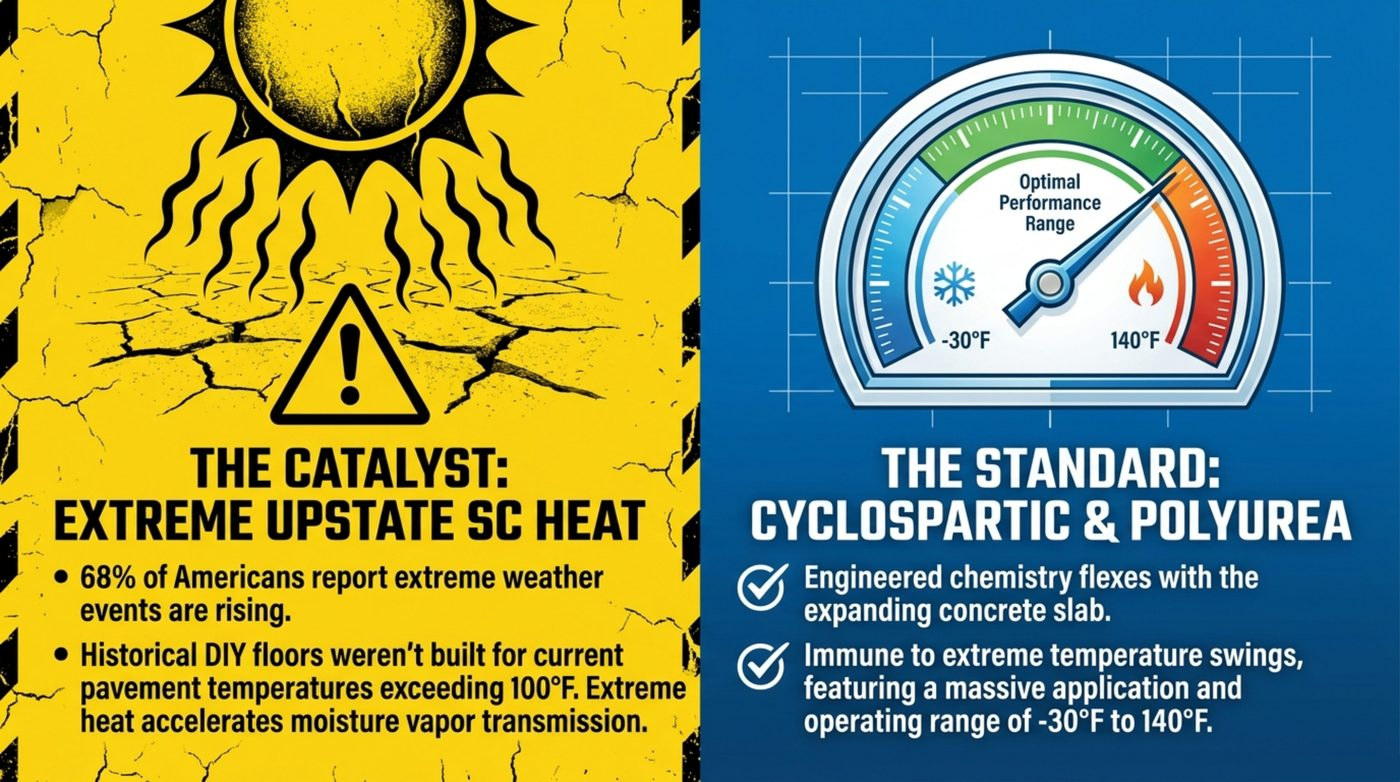
68% of Americans report that extreme weather events are rising, and a garage floor is one of the few surfaces in a home that experiences those events directly and daily. It is not a covered porch. It is a slab that soaks up sun, holds a car with hot tires and a warm engine, and then sits at ambient temperature overnight.
Historical DIY floors were not built for the conditions they now face. A coating formulated for mild swings can look healthy for a season and then fail the first time the pavement temperature climbs beyond what it was designed to tolerate. Households in Arlington and Irving notice it as fading, then chalking, then blisters along the traffic lanes.
The fix is not a thicker coat of the same chemistry. It is chemistry chosen for the range, because the movement the coating has to follow is what breaks it.
What 140°F pavement temperature does to a thin film
Pavement temperatures exceeding 100°F are routine in North Texas summers, and a dark surface in direct sun runs hotter still — which is why a system has to be rated to 140°F rather than to air temperature. Extreme heat accelerates moisture vapour transmission through the slab, sending vapour upward at exactly the moment the coating above it is at its softest.
A rigid film cannot absorb that. Standard epoxy and DIY latex coatings are stiff by formulation: they hold their shape until the stress beneath them exceeds their tolerance, and then they let go all at once. The failure appears as blistering under hot tires, edges lifting near the garage door, and a floor that sounds hollow when you tap it.
A fast-curing hybrid matrix behaves differently. It flexes with the expanding slab instead of resisting it, absorbs the thermal stress, and continues to hold its chemical bond while the slab moves beneath it.
What -30°F does to a coating that cures rigid
The cold end of the range is quieter but no less destructive. A slab at -30°F contracts, and any moisture that worked its way into a hairline crack during the wet months has already frozen and expanded. A coating that dried brittle has no elasticity left to give at that temperature, so the crack telegraphs straight through the film.
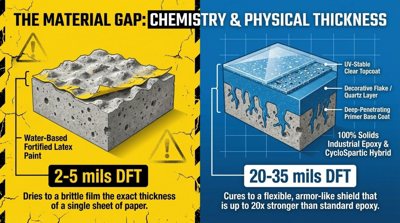
This is the point where thickness and chemistry combine. A 20–35 mil hybrid build has both the body and the flexibility to move with a contracting slab, while a paper-thin film sitting on top of the concrete has only one option: crack with it.
Homeowners in Midlothian and Irving usually discover this after an ice storm, when the meltwater drains and the damage from a winter of cycling becomes visible for the first time.
Why the whole range matters, not just the two end points
The number that matters most is not either endpoint but the distance between them. From -30°F to 140°F, a North Texas slab moves through a 170-degree band every year, and it does so while carrying vehicles, road salt, and moisture vapour rising from below.
A coating that only performs well at room temperature is a coating that performs well for part of the year. The comparison below is the one worth making when you review an estimate, because it puts the two systems side by side against the same conditions your garage already experiences.
| Temperature stress point | Rigid DIY latex and standard epoxy | Fast-curing hybrid matrix system |
|---|---|---|
| Application and operating range | Not built for extreme swings | -30°F to 140°F |
| Pavement temperatures over 100°F | Film softens and stresses; heat accelerates moisture vapour transmission | Absorbs thermal stress while handling vapour pressure |
| Deep freeze at -30°F | Brittle film cracks with the contracting slab | Flexes with the expanding and contracting concrete |
| Slab movement | Cures rigid; cannot follow the concrete | Engineered chemistry moves with the slab |
| Extreme weather exposure | Outdated for current conditions | Rated for the range the garage already sees |
How to check a temperature range without being a chemist
Ask the person quoting your floor for the stated operating range in degrees, and ask what happens at each end. A legitimate system will name both figures. A product that only lists a minimum application temperature and nothing about long-term service is telling you the range was never part of the design.
Then check the schedule. A system rated from -30°F to 140°F can also be returned to full vehicle traffic in 24 hours, which means the coating is designed around real garage use rather than around a long cure. In practice, systems specified for the full range tend to be the same systems specified for a one-day installation.
Finally, look at the failure history of the slab in front of you. Lifting near the garage door means thermal and moisture stress. Blistering in tire lanes means vapour pressure. Fading means UV exposure. Each of those is a symptom of a coating outside its range, and each one repeats until the chemistry is corrected.
Frequently asked questions about floor coating temperature ranges
Is -30°F to 140°F realistic for a Texas garage?
It is the honest working window. Pavement surfaces exceed 100°F in direct summer sun, and a dark coated slab can approach 140°F, while January nights in Mansfield and Midlothian drive the surface well below freezing. A range written around those extremes is a range you can rely on all year.
Why does heat cause a floor coating to bubble?
Because heat accelerates moisture vapour transmission through the concrete while softening the film above it. Rising vapour pressure needs somewhere to go, and a rigid, thin film gives way before the slab does.
Will a thicker coat alone fix a temperature problem?
No. Thickness helps, but a rigid chemistry at 20–35 mils is still rigid. The system has to be able to flex with the slab across the full range from -30°F to 140°F, which is why chemistry and thickness are specified together.
If your garage floor is cracking every winter or blistering every summer, that pattern is a range problem, not bad luck: call (972) 850-7986 for a free assessment in Grand Prairie, Arlington, Irving, Mansfield, Duncanville, DeSoto, Cedar Hill, or Midlothian. For the symptoms to look for before you call, see common epoxy flooring problems, and compare full systems in our side-by-side comparison guides.