Surviving the Texas summer: hot-tire peel and staining
Every July, garage floors across Grand Prairie, Arlington, Irving, Mansfield, Duncanville, DeSoto, Cedar Hill, and Midlothian go through the same test. A car pulls in with tires that have been sitting on blacktop at pavement temperatures that will soften and grip a thin film, then cools in place. By August the tire-shaped patches are visible, and by autumn the coating has lifted. Most homeowners who read this are comparing epoxy floor contractor options around Grand Prairie, TX, so what follows sticks to the details that change in practice.
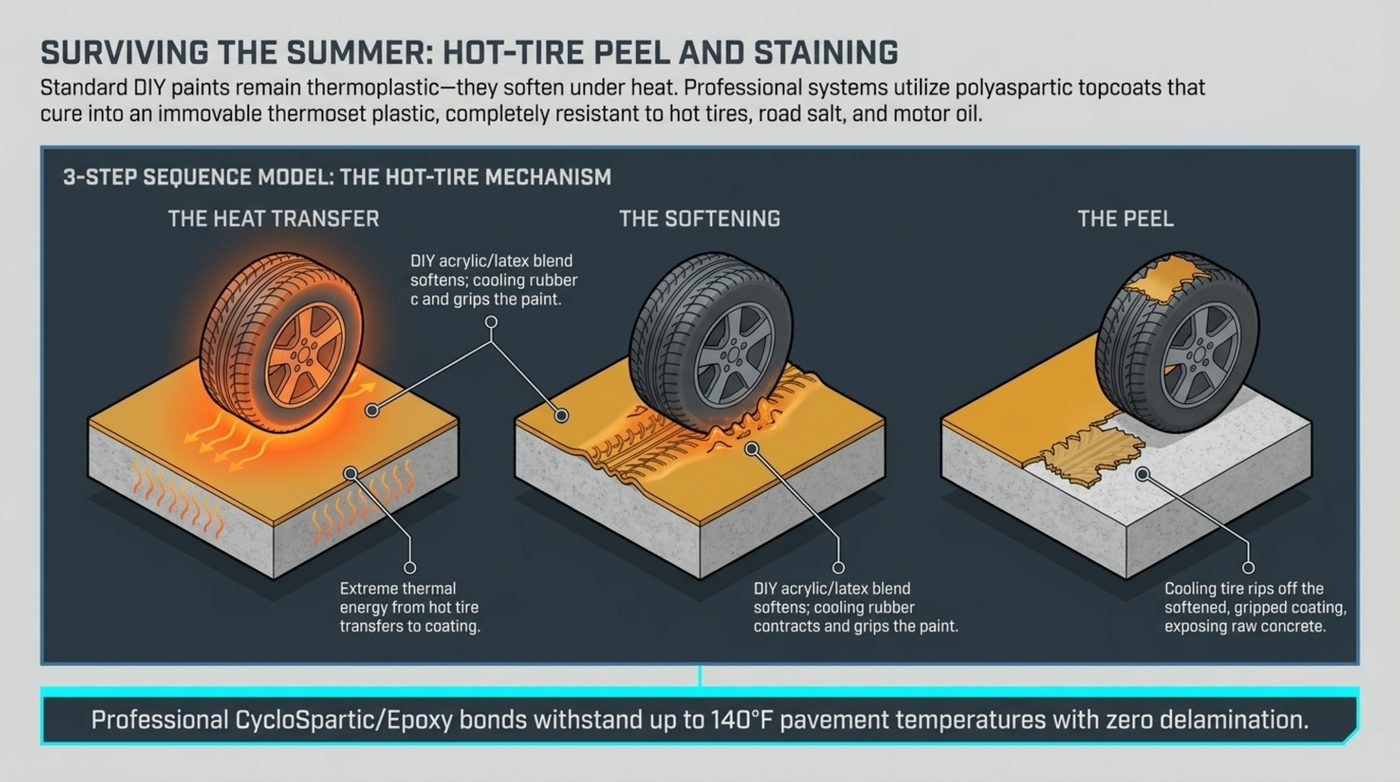
The mechanism is not mysterious. Standard DIY paints remain thermoplastic, meaning they soften when heated again and again. Professional systems use polyaspartic topcoats that cure into an immovable thermoset plastic, completely resistant to hot tires, ice-storm brine, and motor oil. One of those surfaces can be re-softened by a parked car. The other cannot.
The short version
- Standard DIY paints remain thermoplastic and soften when heated again, while professional polyaspartic topcoats cure into a thermoset plastic that heat cannot return to a soft state.
- The failure runs in three steps: heat transfers into the film under the contact patch, a DIY acrylic or latex blend softens, and the cooling tire contracts and rips the coating off.
- Professional cyclic polyaspartic and epoxy bonds withstand pavement temperatures up to 140°F with zero delamination, which is the temperature a sun-exposed North Texas apron reaches in July.
- Staining is what homeowners notice first, and ice-storm brine is the worst of the three fluids because it arrives every winter and sits on the four contact patches already under stress.
- Prevention is a topcoat decision rather than a maintenance decision, because once a thermoplastic film is down no sealer, mat or parking habit will stop a hot tire softening it.
Understanding the sequence explains why hot-tire peel is the most predictable failure in Grand Prairie garages, and why a coating that survived one summer can fail the next.
Thermoplastic versus thermoset
A thermoplastic film has a temperature at which it becomes soft and pliable again. That property is what makes it easy to apply and easy to damage. Once a hot tire raises the surface past that point, the film is no longer a solid, it is a soft layer waiting to be gripped.
A thermoset film cures through a chemical reaction that cannot be undone by heat. It does not return to a soft state at summer temperatures, so the tire has nothing to grip. That is the whole difference between a floor that survives a North Texas summer and one that does not.
This is why the material name on the topcoat matters more than the material name on the base. The topcoat is what touches the tire.
The three-step hot-tire mechanism
The heat transfer. Extreme thermal energy from a hot tire transfers into the coating under the contact patch. The pavement has been collecting heat all day, and the tire arrives carrying it directly into the film.
The softening. A DIY acrylic or latex blend softens under that load. The contact patch is small, the pressure is concentrated, and the film loses the hardness that made it look finished.
The peel. As the tire cools it contracts. Cooling rubber grips the softened, gripped coating and rips it off the slab, exposing raw concrete in a tire-shaped patch. The damage is not gradual wear, it is a tear.
| Stage | DIY acrylic/latex blend | Professional system |
|---|---|---|
| Heat transfer | Thermal energy from the hot tire is absorbed by the film | Bond withstands up to 140°F pavement temperatures |
| Softening | Film softens, cooling rubber grips the paint | Thermoset topcoat does not re-soften under heat |
| Peel | Cooling tire rips off the softened coating, exposing raw concrete | Zero delamination at summer pavement temperatures |
What 140°F pavement temperature means in practice
Professional cyclic polyaspartic and epoxy bonds withstand up to 140°F pavement temperatures with zero delamination. That figure is not a laboratory curiosity, it is the temperature a sun-exposed driveway or a black-topped parking apron reaches in a North Texas July — and a slab along the I-20 and TX-360 corridors can sit in that range for weeks at a time.
The difference between surviving 140°F and softening at it is the difference between a floor that looks the same after five summers and one that has been patched along four tire tracks. Tires cool in place overnight and contract every time, so the peel repeats.
Staining: gas, anti-freeze, and winter brine
Hot-tire peel gets the attention, but staining is what homeowners in Cedar Hill, Midlothian, and Irving notice first. A thin film takes permanent marks from gasoline drips, anti-freeze spills, and the ice-storm brine tracked in on winter tires.
An industrial-grade system is impervious to those fluids. They sit on the surface and wipe up, rather than migrating into the film and leaving a shadow that no amount of scrubbing removes.
Ice-storm brine is the worst of the three, because it arrives with every winter storm and sits on the same four contact patches where the coating is already under stress.
Why the parked car is the harshest test
A garage floor is unusual in that its heaviest loads are static. The same tire sits in the same place for years, transferring heat in summer and brine in winter to the identical square foot of coating.
That repetition is what makes a thermoset topcoat worth the cost. Over a 12+ year lifecycle, the floor never reaches the state where a cooling tire can grip it, so the wear layer stays intact and the finish stays uniform.
Preventing hot-tire peel before it starts
Prevention is a topcoat decision, not a maintenance decision. Once a floor has been coated with a thermoplastic film, no sealer, mat, or careful parking habit will stop a hot tire from softening it. The property has to be built into the chemistry on install day.
That means the slab is mechanically profiled first, the base coat is a high-build resin, and the wear layer is a thermoset polyaspartic topcoat rated for the temperatures a Grand Prairie driveway reaches in July. When all three are in place, the tire simply cannot get a grip on the surface.
For garages in Grand Prairie, Arlington, and Irving that park two daily drivers, this is the single most important specification to confirm before any work begins. Ask what the topcoat is, and ask what pavement temperature it is rated to withstand.
Frequently asked questions about hot-tire peel
What causes hot-tire peel on a garage floor?
A thermoplastic coating that softens under the heat of a hot tire. As the tire cools it contracts and grips the softened film, tearing it off the concrete and exposing raw slab.
Can hot-tire peel be repaired?
Small patches can be cut back and re-coated, but the surrounding film is still thermoplastic, so new tire-shaped failures keep appearing. A permanent fix means a thermoset system over a properly profiled slab.
Do polyaspartic topcoats really resist ice-storm brine and motor oil?
Yes. A professional system cures into a thermoset surface that is impervious to those fluids and withstands pavement temperatures up to 140°F with zero delamination.
If your floor already shows tire-shaped patches, our epoxy flooring problems guide explains what can be salvaged, and the garage floor epoxy page covers the systems we help homeowners compare. Call Grand Prairie Epoxy Floors at (972) 850-7986 for a no-obligation conversation about your Grand Prairie garage.