Slip resistance and return-to-service phasing
Two questions decide whether a new resinous floor is a success: is it safe to walk on when it is wet, and when can it be used again? The first is answered by what goes into the topcoat. The second is answered by a phased schedule that is written in hours for pedestrians and days for vehicles.
Slip resistance is achieved by integrating texturising aggregates directly into the topcoat layer, so the friction is part of the coating and not a mat, tape or paint stripe sitting on top of it. Done properly, that integration is what allows a floor to meet mandatory workplace friction standards even while it is wet.
The return-to-service schedule in the specification runs in three steps. From 0 to 48 hours, all pedestrian traffic is prohibited. At 72 hours, the minimum wait time for vehicular and forklift traffic is met. By five days, the floor is fully cured and can withstand heavy abrasion and chemical exposure.
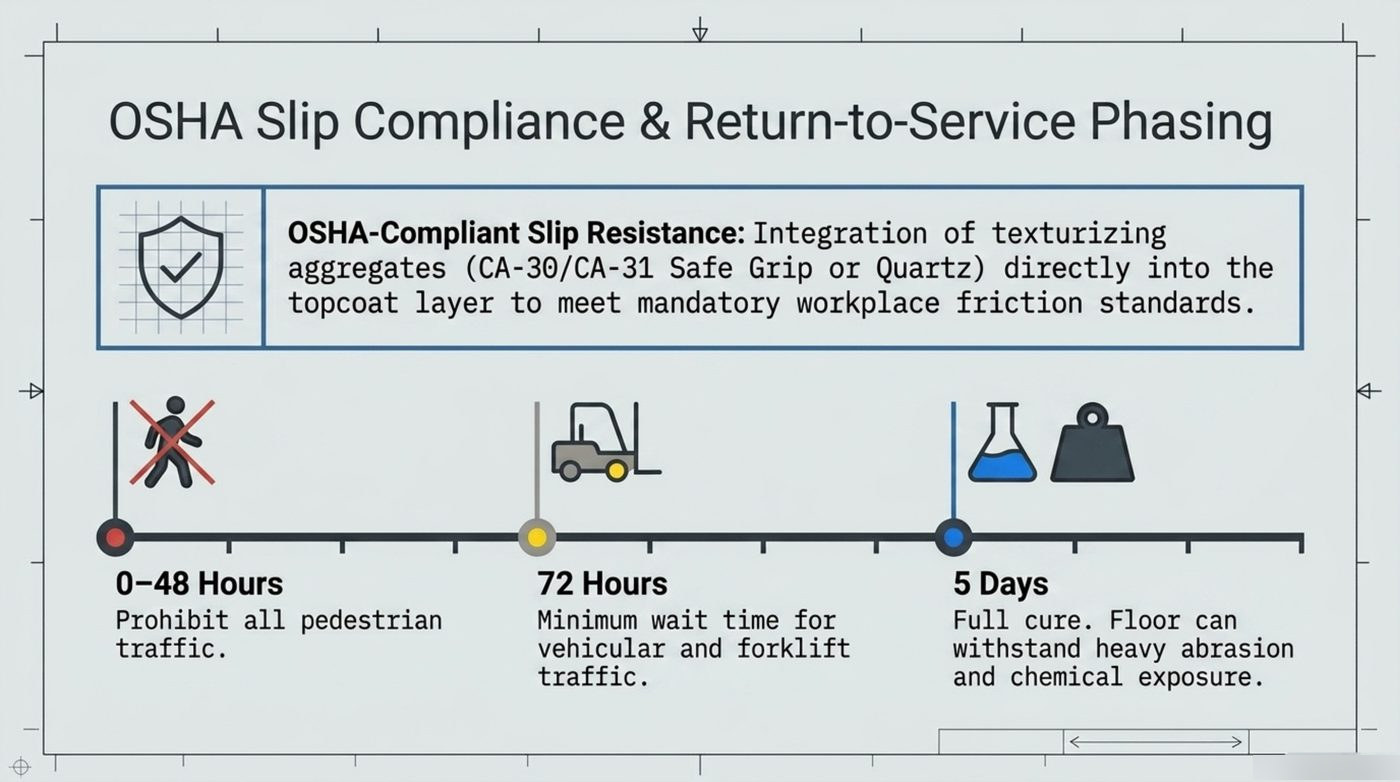
The three phases, in order
The schedule is not a suggestion and it is not negotiable by convenience. Each phase corresponds to a stage in the cure, and the space stays out of service until the material catches up with the demand being placed on it.
| Phase | Timing | Restriction |
|---|---|---|
| Phase 1 | 0-48 hours | Prohibit all pedestrian traffic |
| Phase 2 | 72 hours | Minimum wait time for vehicular and forklift traffic |
| Phase 3 | 5 days | Full cure; withstands heavy abrasion and chemical exposure |
How the aggregate goes into the topcoat
Texturising aggregate is broadcast or blended into the topcoat while it is still open, so the particles bond as the film cures rather than resting on the surface. The result is permanent anti-slip texture integrated into the coating, which is functionally different from a grit-bearing strip of tape or a floor mat that has to be repositioned and replaced.
Aggregate choice controls the feel as much as the friction. A fine graded quartz leaves a light tooth that is comfortable on bare feet and still changes the coefficient of friction when wet; heavier profiles trade comfort for grip. On a garage apron in Grand Prairie that bakes through a 140°F summer and then takes ice-storm brine, the lighter profile handles most of the hazard while keeping the floor sweepable.
What "OSHA-compliant" actually commits a floor to
Slip resistance in a workplace is a mandatory friction standard, not a finish preference. A floor specified to meet it integrates texturising aggregate to move the wet coefficient of friction into compliance, which is why commercial and industrial spaces rarely get a smooth topcoat regardless of how good it looks on a sample board.
The same logic applies in residential spaces that behave like workplaces — a Cedar Hill garage converted into a gym, a Midlothian workshop with a wet bay, a basement in Arlington used for equipment repair. The requirement is set by the traffic and the spill potential, and once a floor is textured to meet it, the texture does not wear out of the film.
The application window and why scheduling matters here
The system carries a documented application window of -30°F to 140°F, which is wide enough that North Texas weather rarely blocks a project outright. What it does affect is cure speed: within that window, cooler slabs slow the reaction and warmer slabs accelerate it, so the return-to-service clock runs against the conditions of the day rather than a fixed number of hours on a chart.
That is why phasing and weather are planned together. If a cold front is coming through Duncanville the week after installation, the five-day full-cure milestone is the number worth protecting, because heavy abrasion and chemical exposure are what the floor will face for the next decade and a half. Scheduling the work so that the long end of the phasing lands on days the vehicle can stay outside is the single most useful planning decision a homeowner makes.
Living with the floor through the phases
Practically, the phases mean the space is unavailable on day one and day two, a car can return on day three, and the floor reaches its full rating at five days. During the pedestrian prohibition, keep the door closed to traffic and leave ventilation running — foot traffic during the first 48 hours is the most common way a homeowner damages a floor that was installed correctly.
After full cure, maintenance settles into routine sweeping and mopping. The aggregate that provides the grip also traps fine grit at the surface, so sweeping does double duty: it keeps the floor clean and it keeps abrasive dust from working at the film under tires. Details on how texture interacts with the rest of the build are covered on the flake and chip systems page, and typical project pricing sits in the cost guide.
Frequently asked questions about slip resistance and return to service
When can I walk on the new floor?
Not during the first 48 hours, when all pedestrian traffic is prohibited. Wait until the 72-hour mark for minimum vehicle traffic, and five days for full cure, at which point the floor withstands heavy abrasion and chemical exposure.
When can I park a car on it?
At 72 hours, which is the minimum wait time for vehicular and forklift traffic. Parking earlier risks marring a film that has not finished curing, and the damage typically shows as flat spots and tire-shaped discoloration rather than a visible crack.
Does the anti-slip texture wear off over time?
No. The texturising aggregate is integrated into the topcoat layer rather than applied over it, so the friction is part of the coating. Routine sweeping keeps grit from loading the surface, which is the maintenance step that protects the texture and the finish underneath it.
Tell us how many days the space can realistically stay empty and we will build the schedule around it. Call Grand Prairie Epoxy Floors at (972) 850-7986 to plan a project in Grand Prairie, Irving, DeSoto or Midlothian, or compare system builds and thicknesses in our comparison guides first.