Specifying a double-broadcast resinous floor
Most garage floor failures around Grand Prairie, Arlington and Mansfield are not caused by bad resin. They are caused by a specification that was never written down. When a homeowner asks for "the good epoxy" and nobody defines what that means, the decision falls to whoever is standing on the slab with a mixer — and that person usually works with whatever is left on the truck. A double-broadcast system removes the guesswork. Every layer, every film thickness and every aggregate application is documented before the first grinder touches concrete, so the finished floor can be checked against a stated number instead of an opinion.
A double-broadcast floor is exactly what the name describes. Aggregate is broadcast into wet resin twice, not once. The first broadcast goes into the base coat and becomes the structural grit that everything above it grips. The second broadcast goes into an intermediate coat and builds the dense matrix that absorbs traffic. A pigmented topcoat then seals the aggregate and becomes the surface you actually walk on.
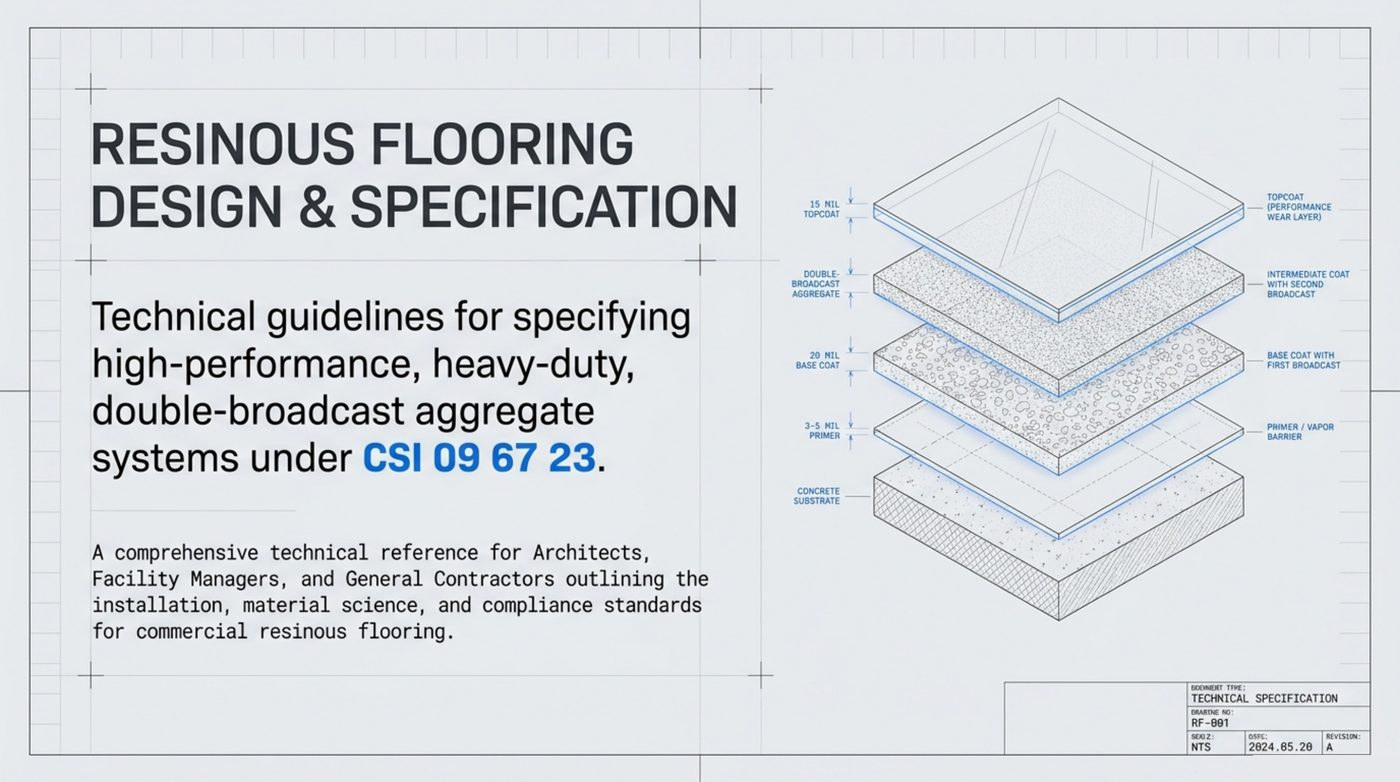
This system sits under CSI 09 67 23, Resinous Flooring — the master-format section architects use for this class of work. The reference specification is numbered RF-891, revision A. That revision letter matters more than it sounds, because the letter is the version that is binding. A crew that installs to a superseded revision has installed something other than what was sold.
The layer stack, top to bottom
Read from the concrete up, the specified build is a primer or vapor barrier at 3 to 5 mils, a base coat carrying the first aggregate broadcast at 20 mils, an intermediate coat carrying the second broadcast, and a performance topcoat wear layer at 15 mils. The broadcast layers do not carry a published film thickness the way the wet coats do, because their depth is governed by how completely the aggregate is applied — dense, uniform, and refusing no more grain.
Add the wet coats together and a double-broadcast floor lands near 38 to 40 mils over a slab that has been profiled correctly. That is roughly three times the film thickness of the single-coat epoxy kits sold in Grand Prairie and Midlothian home centers, and it explains why the two products behave nothing alike after five summers of heat cycling.
| Layer | Stated build | What it does |
|---|---|---|
| Primer / vapor barrier | 3-5 mils | Seals the slab surface, controls vapor drive, anchors the system |
| Base coat with first aggregate broadcast | 20 mils | Keys the first layer of aggregate into the bond line |
| Intermediate coat with second broadcast | Broadcast-driven | Stacks grain so impact load is shared across the matrix |
| Performance topcoat wear layer | 15 mils | Seals the aggregate and becomes the walking surface |
| Total system build | 38-40 mils | Composite film over a profiled slab |
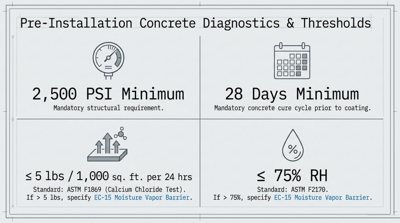
The 3 to 5 mil primer is the thinnest layer in the stack and the easiest to skip, which is precisely why it is specified. Its job is not wear resistance — it is adhesion and vapor control. On a Duncanville or Irving slab that carries high moisture readings, that thin film is the difference between a floor that stays bonded and a floor that lifts in sheets.
Why the aggregate goes in twice
One broadcast gives you texture. Two broadcasts give you mass. The first layer sits at the bond line and mechanically keys the base coat to the profile that preparation opened. The second layer stacks more grain on top of it, so the wear surface becomes a deep, interlocking matrix of silica sand held in resin rather than a sprinkle sitting near the top of the film.
That depth matters in a working garage. Hot tires, floor jacks and dropped tools load the same few square inches over and over. In a single-broadcast floor the grain sits close to the surface and can be sheared out. In a double-broadcast floor the load is shared across grains stacked through the full 38 to 40 mil build, and the topcoat above them has 15 mils of material to give before anything reaches the aggregate.
It also changes how the floor ages. Aggregate locked in two layers stays locked when the slab moves slightly through a DeSoto or Cedar Hill clay-soil cycle. Grain held in one shallow layer works loose at the perimeter first, which is why so many failed garage floors in Grand Prairie fail from the edge inward.
What a 15 mil wear layer buys you
The performance topcoat is the only part most homeowners ever touch, and at 15 mils it is specified as a wear layer rather than a sealer. A sealer is measured in single mils. Fifteen mils is a film you can abrade, recoat and repair without ever reaching the broadcast underneath.
That headroom is what makes maintenance realistic. When a Grand Prairie floor eventually needs attention — a chemical spill, a hot-tire mark, a gouge from a dropped tool — a contractor can remove a few mils, re-coat and blend, because more than 10 mils of topcoat remain over the aggregate. On a thin sealer system the same repair exposes bare grain and the repair never disappears.
The topcoat spec also has to be read as part of the whole. A 15 mil topcoat over a 20 mil broadcast base and a 3 to 5 mil primer is a system. Upgrading one of those layers while cheapening the others does not improve the floor; the weakest layer in the stack sets the service life.
Checking a bid against the written specification
When you compare quotes in Mansfield, Irving or Midlothian, ask every contractor the same four questions and write the answers down. A bid that cannot answer in mils and layer counts is a bid you cannot compare to any other.
- Topcoat film thickness stated in mils, not "heavy" or "commercial grade."
- Number of aggregate broadcasts stated as a number — one or two.
- Primer or vapor barrier called out separately from the base coat, with its own film thickness.
- Total system build stated as a range, with each layer accounted for.
Those answers turn a stack of estimates into a real comparison, and they tell you quickly whether a quote was built from a specification document or improvised on the morning of the job.
Frequently asked questions about double-broadcast resinous flooring
Is a double-broadcast floor worth the extra cost over a single broadcast?
It depends on the load. For a two-car garage in Grand Prairie that mostly parks daily drivers, a single broadcast can last. For shops in Midlothian or Irving with lifts, welding, heavy tool storage or brine-heavy winter traffic, the second broadcast and the 15 mil topcoat are what keep the surface from wearing through to bare grain. The material difference is real and so is the service life.
How does the thickness compare to a store-bought epoxy kit?
A boxed single-coat system typically lands in a thin film measured in single mils. The build specified here is 3 to 5 mils of primer, a 20 mil broadcast base and a 15 mil topcoat, for roughly 38 to 40 mils total. That is the difference between a coating and a floor.
Can a double-broadcast system go over an existing coated garage floor?
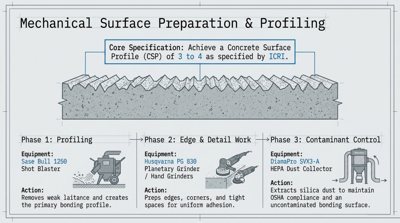
Sometimes, but only after the existing coating is tested for adhesion and the slab is checked for moisture. Loose or failing coating has to come off, and the surface still has to reach the specified profile before a base coat is applied. Skipping that step is how delamination starts.
If you want a floor specified in mils rather than described in adjectives, Grand Prairie Epoxy Floors helps homeowners across Grand Prairie, Arlington, Irving and Mansfield compare local providers who work to a written specification. Call (972) 850-7986, review the epoxy flooring checklist before you collect quotes, or see how the layers stack up in our comparison guides.