Pre-installation concrete diagnostics: the numbers that matter
Every resinous floor is a bet on the slab underneath it. In North Texas that bet is settled long before a roller is wet, by a small set of measurements that most homeowners never see and many contractors never take. Two of those measurements are structural, two are environmental, and all four are pass or fail. There is no negotiating with them.
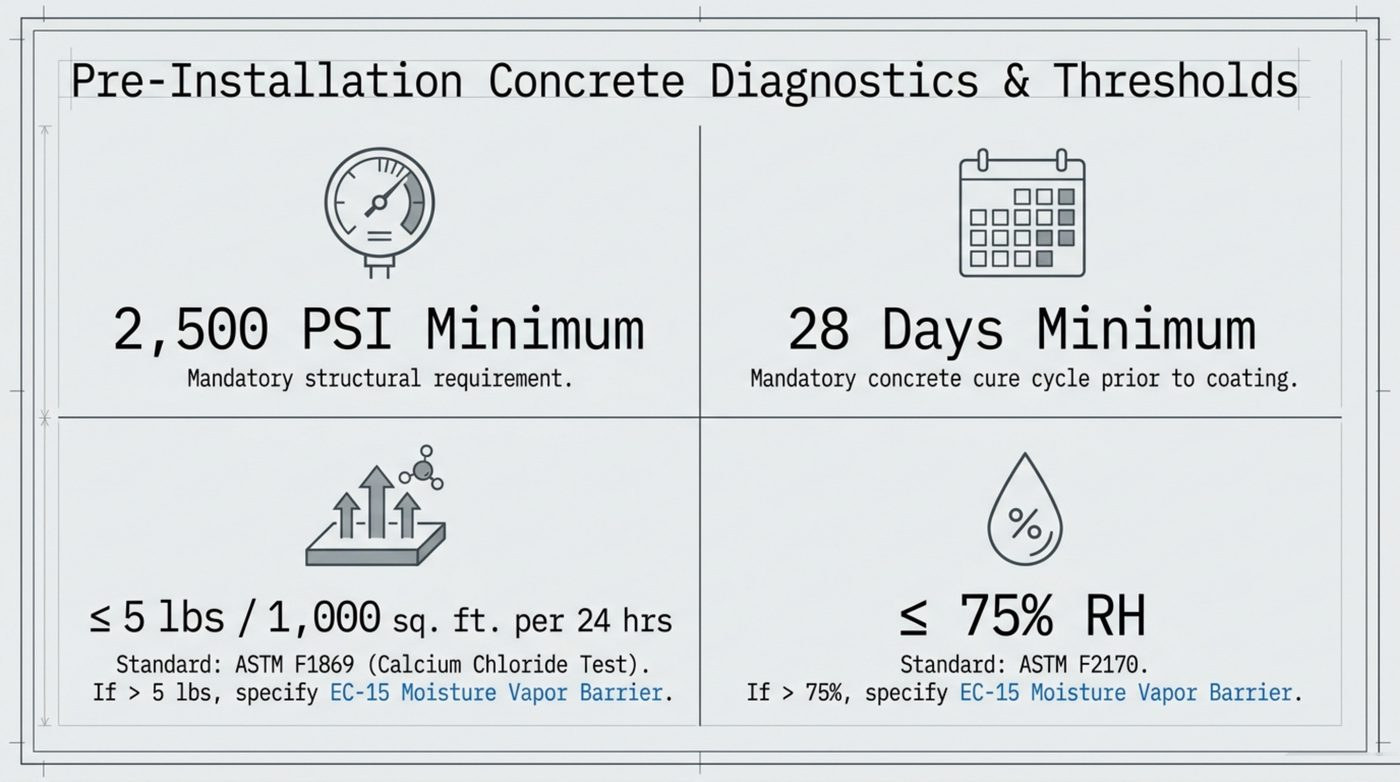
The numbers are simple. Concrete must reach 2,500 PSI minimum compressive strength, and it must cure for 28 days minimum before any coating goes down. Moisture vapor transmission must measure at or below 5 lbs per 1,000 square feet per 24 hours on the calcium chloride test, ASTM F1869. Relative humidity inside the slab must measure at or below 75% on the ASTM F2170 in-situ probe test. Anything outside those limits changes the specification, not just the schedule.
This is the part of a garage floor project in Grand Prairie, Mansfield or Midlothian, from the I-30 corridor down to US-67, where the money is actually decided. A slab that fails diagnostics does not get a cheaper install — it gets either a moisture vapor barrier in the system or a different plan entirely.
Why 2,500 PSI and 28 days are non-negotiable
Compressive strength is the slab's ability to hold a load without deforming, and 2,500 PSI is the floor of what a resinous system can be bonded to. Below that, the concrete is the weak link. The film may hold perfectly and still fail, because the material it is attached to crushes and powders under traffic. Contractors read this as a mandatory structural requirement, not a preference.
The 28-day cure cycle matters for a different reason. New concrete is not done curing at 7 days, or even at 14. It is still releasing water vapor from within, and a coating applied over that window traps the vapor under a film that will not let it pass. The result is a floor that blisters from below — the classic "why is my new epoxy bubbling" call we hear from Irving and Midlothian homeowners with freshly poured slabs.
Both numbers come from the same idea: the slab has to be stable before it is sealed. A quick-set floor is not faster, it is just failed earlier.
The two moisture tests do different jobs
ASTM F1869, the calcium chloride test, measures how much moisture vapor is escaping the slab across a 24-hour window and reports it in pounds per 1,000 square feet. It answers the question "how much water is coming out of this concrete right now?" The threshold is 5 lbs. Exceed it, and a moisture vapor barrier has to be specified into the system — usually as a dedicated primer layer under the base coat.
ASTM F2170 measures relative humidity inside the slab itself, using probes placed at depth, and reports a percentage. It is the stricter of the two in practice, because it reaches moisture that the surface test can miss. The threshold is 75% RH. Above that, the same conclusion applies: the system needs a vapor barrier.
| Diagnostic | Standard | Threshold | Action if exceeded |
|---|---|---|---|
| Compressive strength | Structural requirement | 2,500 PSI minimum | Slab is unsuitable as-is |
| Cure cycle | Placement record | 28 days minimum | Wait before coating |
| Moisture vapor transmission | ASTM F1869 calcium chloride | 5 lbs / 1,000 sq ft / 24 hrs | Specify moisture vapor barrier |
| Relative humidity | ASTM F2170 in-situ probe | 75% RH | Specify moisture vapor barrier |
Notice that both environmental failures lead to the same remedy. That is the practical value of running the tests as a pair: if either one comes back high, the system gains a barrier layer, and the quote should show it as a line item.
What happens when the tests are skipped
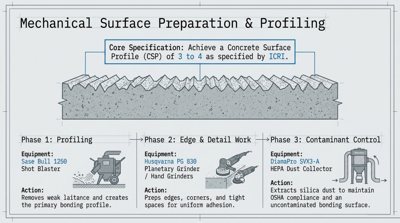
Skipping diagnostics does not usually show up on installation day. It shows up a season or two later, when vapor pressure that has been building under the film finally wins. In a Grand Prairie garage that looks like bubbles and blisters, then edges that curl, then sheets of coating that peel away from a slab that still looks fine underneath.
The failure is often misdiagnosed as bad material. It rarely is. A floor that comes up in sheets with clean concrete showing on the back of the film was bonded to a slab that was still driving moisture, or a slab whose surface was never profiled to hold a bond in the first place.
This is also why an experienced installer wants to see the numbers before pricing the job. Two identical-looking garages in Mansfield and DeSoto can require different systems entirely based on readings taken with a hammer drill and a probe.
Planning around a failed reading
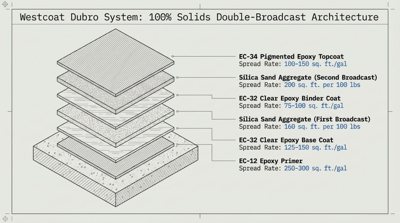
A high reading is a specification change, not a dead end. A moisture vapor barrier primer goes in below the base coat, the system build grows by that layer, and the schedule may shift by a day to let it cure. On a slab that fails compressive strength, the honest answer is that a resinous floor is the wrong product and the slab needs remediation first.
What you want from a contractor is the reading itself, not a summary of it. Ask for the F1869 number in pounds and the F2170 number in percent relative humidity, along with where the test was taken. In a garage with a floor drain or a slope, the reading at the low corner can differ from the reading at the door, and the worst number governs the specification.
Numbers also let you compare bids honestly. A quote that includes a moisture vapor barrier and a quote that does not are not the same job, even when they look the same on one page.
Frequently asked questions about pre-installation concrete diagnostics
How long do I have to wait after pouring a new garage slab?
At minimum 28 days of cure before any coating is applied, and that clock starts from placement, not from when the slab looks dry to the eye. Testing at 28 days gives you the actual moisture reading; if it is still above 5 lbs per 1,000 square feet or 75% RH, the schedule moves again.
My garage floor is 20 years old — do I still need moisture testing?
Yes. Older slabs in Arlington and Irving often read high because of missing or failed under-slab vapor retarders, rising water tables, or drainage that changed over the years. Age does not predict moisture. Only a test does.
Is the calcium chloride test or the in-situ probe the better measure?
They measure different things — vapor escaping the surface versus humidity inside the slab — and the specs here use both, F1869 at 5 lbs per 1,000 square feet per 24 hours and F2170 at 75% RH. Run both, and specify the barrier if either one exceeds its limit.
Before you sign anything, ask to see the diagnostics in writing. Grand Prairie Epoxy Floors helps homeowners in Grand Prairie, Arlington, Irving, Mansfield and Midlothian compare local providers who test first and specify second — call (972) 850-7986, check the pre-installation checklist, or read our guide to common epoxy flooring problems to see what skipped diagnostics look like two years later.