Thermal dynamics: stopping outgassing and delamination
Outgassing is the reason a garage floor that looked perfect in April can be covered in blisters by August. The mechanism is thermal, and it is one of the few failures in a resinous floor that has nothing to do with wear. No amount of traffic causes it. Heat does, working on moisture that is already inside the slab. If you are here looking into epoxy floor delamination causes, the sections below walk through the process from the first quote to the finished job.
The sequence is straightforward. A slab holds moisture. As the concrete heats, that moisture turns to vapor and expands, and it moves toward the surface. If a film is sitting on top of the slab while that vapor is still being released, the pressure finds the path of least resistance — usually a weak spot in the bond line or a pinhole in the film — and lifts the coating from below. The result is edge blistering and surface bubbles, and once a blister opens, water gets under the film and the failure spreads.
The short version
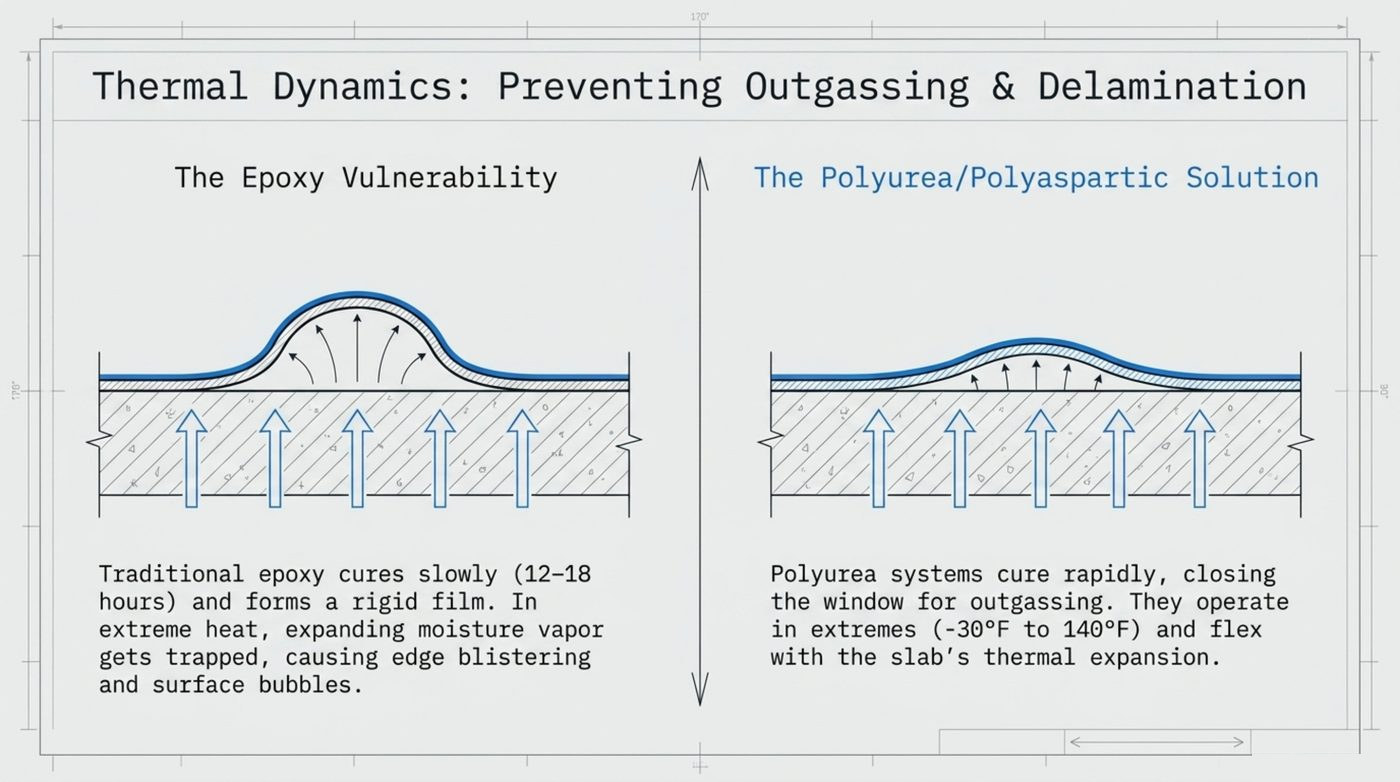
- Traditional epoxy cures slowly over 12 to 18 hours and forms a rigid film, leaving an outgassing window where rising vapour pushes into material still soft enough to deform around it.
- Rigidity compounds the problem once the slow-curing epoxy sets hard, so stress concentrates at the perimeter and the first failure is often edge blistering rather than a mid-field bubble.
- Polyurea and polyaspartic systems cure rapidly, which closes the outgassing window before vapour works into the film, and they flex with the concrete across -30°F to 140°F.
- Delamination that started as outgassing leaves the concrete clean behind the film with no residue stuck to the back of the coating, which shows the bond never developed.
- A rapid cure reduces the outgassing window but does not eliminate vapour, so the slab still has to read at or below 5 lbs per 1,000 square feet on ASTM F1869 and 75% RH on ASTM F2170.
What makes this a North Texas problem specifically is the temperature swing. Grand Prairie, Arlington and Mansfield garages can sit near freezing on an ice-storm night in January and then push past 100°F at the surface in July with a sun-loaded door in front of them, and an I-20 corridor slab in full afternoon sun runs hotter still.
The epoxy vulnerability: a slow, rigid cure
Traditional epoxy cures slowly — 12 to 18 hours — and it forms a rigid film as it does. That combination is what creates the outgassing window. For the better part of a day, the film on the floor is not fully set, so vapor that is rising out of the slab has somewhere to go: it pushes into the material while the material is still soft enough to deform around it.
Rigidity compounds the problem. Once a slow-curing epoxy does set, it sets hard. It does not move with the concrete. When the slab expands in summer heat, the film resists instead of flexing, and the stress concentrates at the perimeter where the coating meets a wall or a stem. That is why the first failure is so often edge blistering rather than a bubble in the middle of the field.
None of this means epoxy is the wrong material. It means the cure window has to be managed, and on a slab with any real moisture load, a straight slow-cure epoxy system leaves that window open longer than it should be.
How outgassing becomes delamination
A blister is a local failure. Delamination is what happens when the failures join up. Once vapor has lifted a section of film, the edge of the lifted area is exposed, and the bond line from that point inward is compromised. Walking on a blistered floor, driving over it, or rolling equipment across it in February all break the blisters open and feed water into the gap below.
The diagnostic pattern is consistent. Delamination that started as outgassing leaves the concrete clean behind the film, with no significant residue of concrete stuck to the back of the coating. That tells you the bond never developed, rather than the coating being torn out of the surface.
It also explains why a floor can fail in one garage and hold in the next one on the same street. The difference is not the material brand. It is the moisture reading in the slab and how fast the film closed over it.
The polyurea and polyaspartic solution
Polyurea and polyaspartic systems attack the problem from the cure side. They cure rapidly, which closes the outgassing window before vapor has time to work its way into the film. The slower the cure, the longer vapor has to escape into soft resin; the faster the cure, the smaller that opening gets.
They also move with the slab. These systems operate across extremes from -30°F to 140°F and flex with the concrete's thermal expansion instead of fighting it. On a DeSoto or Cedar Hill garage that sees ice-storm cold and 140°F summer pavement on the same slab, that flexibility is what keeps the film bonded at the edges through the annual cycle.
| Behavior | Traditional epoxy | Polyurea / polyaspartic |
|---|---|---|
| Cure time | 12-18 hours | Cures rapidly |
| Film behavior | Rigid film | Flexes with slab thermal expansion |
| Outgassing window | Open — vapor can enter soft resin | Closed early by fast cure |
| Service temperature range | Limited by film rigidity | -30°F to 140°F |
| Typical failure mode in heat | Edge blistering and surface bubbles | Resists vapor-driven lift |
Read across the table and the two columns describe the same physics handled two different ways: one slows the vapor and one closes the window.
What this means in a Grand Prairie garage
The practical takeaway is not that one material replaces the other. It is that the cure speed of the top end of the system has to be matched to the moisture load of the slab. A slab that reads high on the ASTM F1869 or ASTM F2170 tests has more vapor to manage, and a system that closes its window quickly is safer over that slab than one that stays open for 12 to 18 hours.
Season matters too. A garage floor installed in an unheated Midlothian garage in February is curing in a different thermal environment than the same floor poured in Irving in August. Rapid-cure systems are far less sensitive to that ambient temperature than slow-cure epoxy, which is why they hold up better across a Texas year.
The right answer is usually a system, not a single product: a properly tested slab, a moisture vapor barrier where the readings call for one, and a fast-curing top end that closes the outgassing window and flexes with the slab through the heat and clay cycle.
Frequently asked questions about outgassing and delamination
Why is my epoxy floor bubbling in the heat?
Bubbles that appear with rising temperatures are almost always vapor escaping from the slab and being trapped under the film. It points to a moisture reading that was never tested, a barrier that was never specified, or a film that took too long to cure and let vapor into the resin while it was still soft.
Can a bubbling floor be repaired, or does it have to be replaced?
Local blisters can sometimes be cut out, dried and re-coated, but if the edges have started to curl the bond is already gone across that area. The real fix is to identify the moisture source, test the slab, and rebuild with a system that closes the outgassing window and includes a vapor barrier where the numbers require it.
Does a rapid-cure system still need moisture testing?
Yes. A fast cure reduces the outgassing window, it does not eliminate vapor. The slab still has to be within 5 lbs per 1,000 square feet per 24 hours on ASTM F1869 and 75% RH on ASTM F2170, or a moisture vapor barrier enters the specification.
If your floor blistered after the first hot week of summer, the cause is almost certainly below the surface. Grand Prairie Epoxy Floors helps homeowners in Grand Prairie, Mansfield, Arlington, DeSoto and Midlothian compare local providers who test the slab before they coat it — call (972) 850-7986, read our guide to epoxy flooring problems, or see the options side by side in our comparison guides.